
Fiber splicing & termination
Fusion splicing is not a difficult skill. Doing it consistently, at 2 a.m., in a bucket, in February, and having every splice certify — that is the difficult part. It is what we build the crew around.
Capability
What we splice
We work single-mode and multimode, individual fibers and ribbon, in closures, cabinets, trays and cassettes. Loose tube, ribbon, micro-duct, armoured and drop cable all get prepared to the manufacturer's spec rather than to whatever is quickest.
Splicing
- Single-mode fusion splicing — OS2, 9/125 µm, core-alignment
- Ribbon and mass fusion — 12-fiber at a time for high-count builds
- Multimode — OM3, OM4 and OM5 for campus and data center
- Mechanical splicing where the application genuinely calls for it
- Mid-span access and branch splicing without cutting the through-count
Termination
- Pigtail splicing into LC, SC, ST and MPO cassettes
- Field-installable connectors where splice-on is not practical
- Splice closures — dome and in-line, aerial, pedestal and vault
- Rack-mount enclosures, trays, cassettes and patch fields
- Fiber counts from a 2-fiber drop to 864-count backbone
Why we shoot every splice
A fusion splicer's estimated loss is exactly that — an estimate, calculated from what the camera can see. It does not detect a stressed fiber behind the splice point, a tight bend in the tray, or a dirty connector three panels away. The OTDR does. So no splice leaves our tray on the strength of the splicer's own number.
Reference
What we work to
Typical acceptance values. Your project spec always governs — these are what we aim for when nobody has told us otherwise.
| Item | Target |
|---|---|
| Single-mode fusion splice loss | Typically ≤ 0.10 dB, bi-directionally averaged |
| Multimode fusion splice loss | Typically ≤ 0.10 dB |
| Mechanical splice loss | Typically ≤ 0.30 dB — used only where specified |
| Connector insertion loss | ≤ 0.50 dB, inspected and cleaned before mating |
| Connector endface | Scoped to IEC 61300-3-35 before every mate |
| Verification | Bi-directional OTDR on every splice point |
| Documentation | Traces, splice log and as-built at closeout |
If your specification is tighter than the above, say so at quote stage — it changes method and time, and we would rather price it correctly than discover it at acceptance.
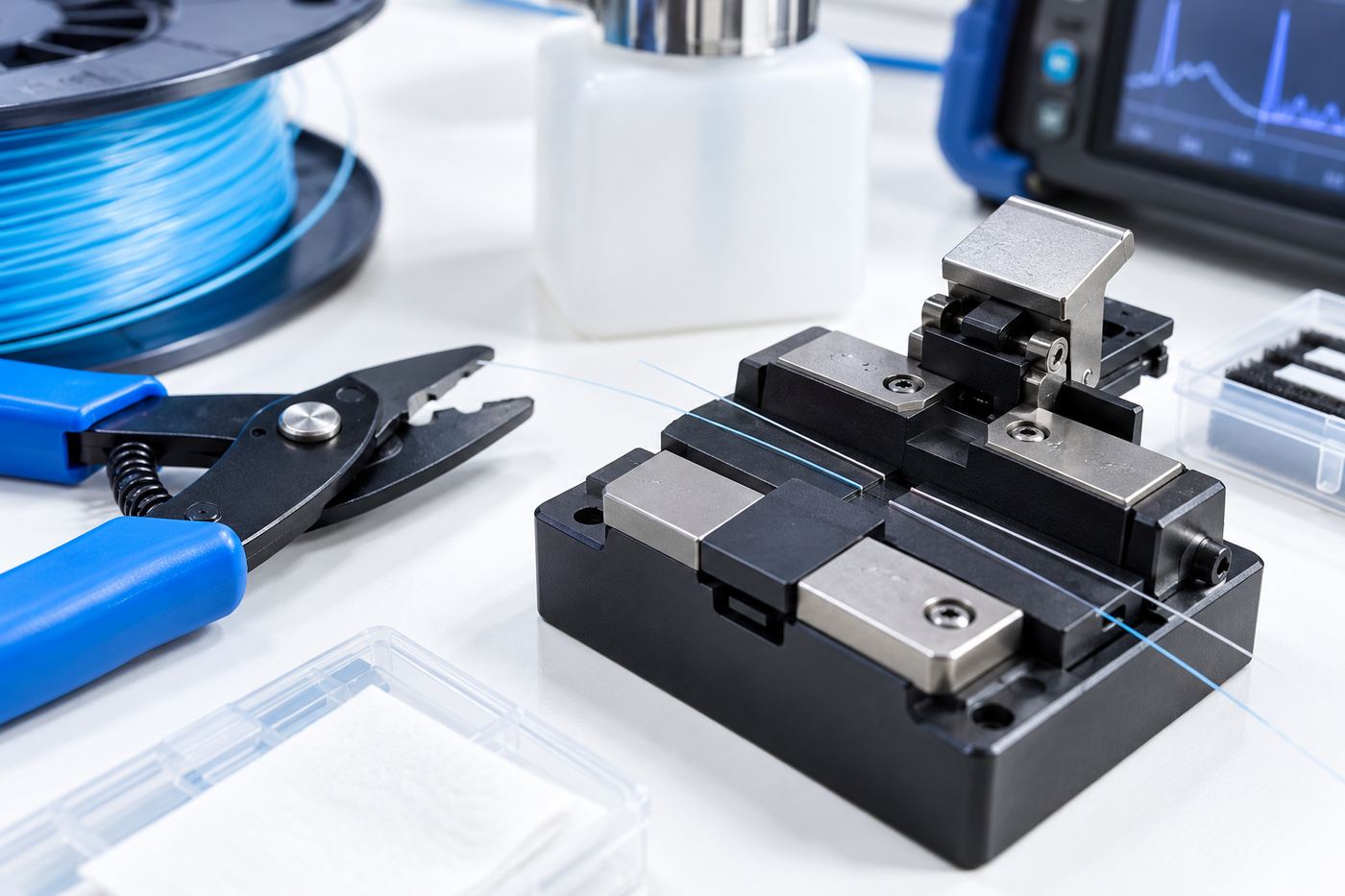
Detail
The part that decides whether it certifies
A clean cleave and a spotless endface are what a trace actually measures. Everything upstream of the splicer — prep, cleaning, cleave angle — either holds or it does not, and there is no fixing it after the fact.
In the field
What this work looks like


Frequently asked questions
Do you work aerial, underground and inside plant?
All three. Aerial splicing from a bucket, underground in vaults, handholes and pedestals, and inside plant in racks and wall-mount enclosures. See aerial and underground construction for the placement side.
How many splices can a crew do in a day?
It depends far more on access than on splicing. A rack-mount cassette in a clean data center is very different from a mid-span aerial closure in traffic. When we quote we give you a realistic production rate for your specific conditions rather than a best-case number we would then miss.
Can you splice into an existing live cable?
Yes — mid-span access and branch splicing on live plant is routine. It needs planning: which buffer tubes are in service, what the maintenance window is, and who needs to be notified. Bring us in early enough and it is straightforward.
What if a splice fails certification later?
We come back and fix it. Every splice is traced before we leave, so a failure after the fact usually means something changed on site — but sorting that out is our problem, not yours to argue about.

Send us the scope. We will send back a number.
Drawings, a footage count or a rough description — whatever you have. We will tell you what we can self-perform, what it costs and when we can mobilise.