
Testing & certification
A fiber link is not finished when it is spliced. It is finished when somebody can prove — on paper, bi-directionally, against a loss budget — that it performs. That proof is the deliverable.
Capability
Tier 1, Tier 2 and finding the fault
We test what we build and we test what other people built. Taking over a link somebody else installed is common — and the OTDR is not interested in whose fault anything is, which makes it a good way to settle an argument before it becomes one.
Tier 1 — OLTS
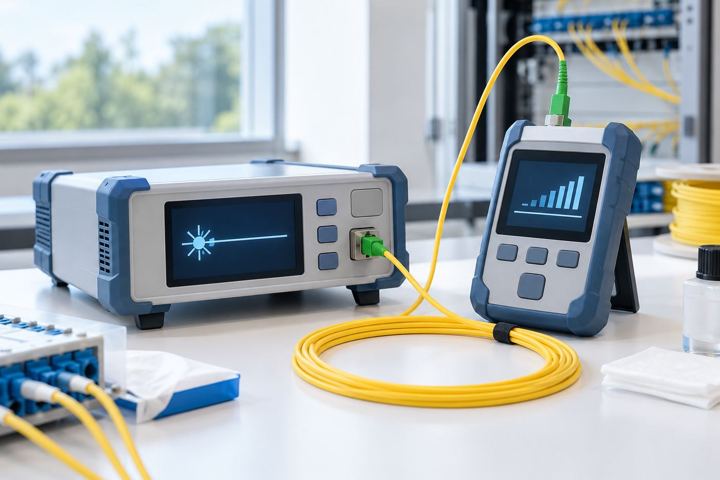
End-to-end insertion loss with a light source and power meter, measured against the calculated loss budget for the link: fiber attenuation, splice count, connector count and a margin. It answers one question — does this link pass or fail?
Tier 2 — OTDR
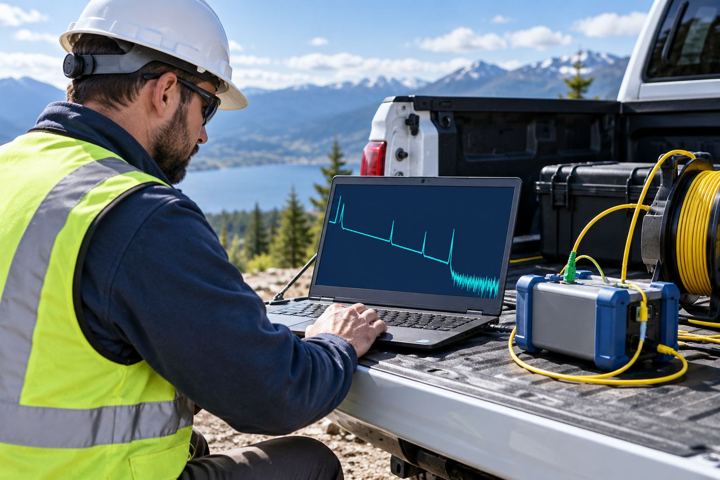
A trace along the fiber showing every event: splices, connectors, bends, breaks and the attenuation between them. It answers the harder question — where is the loss, and is anything sitting just inside tolerance today that will drift out of it next winter?
Also
- Bi-directional testing and averaging — the only honest way to measure a splice between fibers of differing mode-field diameter
- Fault location on dark or failing fiber, with a distance to the break
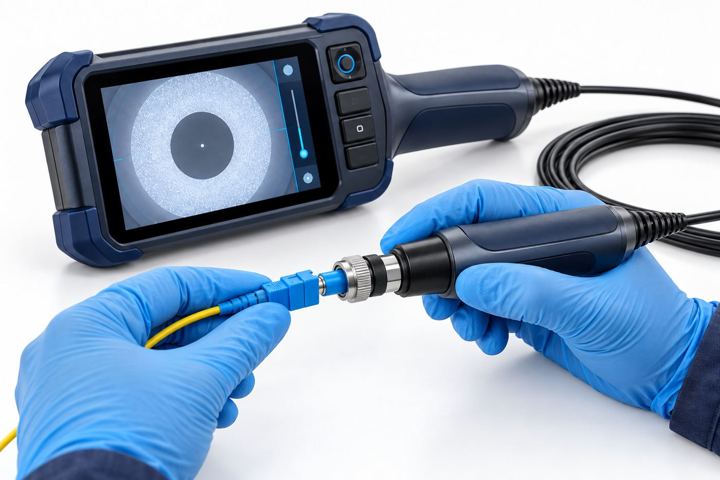
- Connector endface inspection to IEC 61300-3-35 — the single most common cause of failure
- Visual fault location for short links, tray tracing and polarity
- Loss budget calculation before the build, so the design is provably achievable
- Acceptance documentation in the format your customer requires
Around 80% of the "bad fiber" we get called out to is a contaminated connector. It is worth scoping before anyone starts pulling cable out of the ground.
Process
How certification runs
-
Budget first
We calculate the expected loss from the design before testing, so there is an objective number to pass or fail against.
-
Inspect & clean
Every endface is scoped and cleaned before mating. Testing a dirty connector produces a dishonest number.
-
Test both ways
OLTS then OTDR, from both ends, averaged. Single-direction traces hide and exaggerate splice loss in equal measure.
-
Report
Traces, results and as-builts packaged in the format you need for your own acceptance or handover.
In the field
What this work looks like
Frequently asked questions
Can you certify fiber another contractor installed?
Yes, and it is a common request — usually when a link will not pass or a customer wants independent verification before accepting a handover. We report exactly what the traces show.
Why does bi-directional testing matter?
When two fibers with slightly different mode-field diameters are spliced, an OTDR shot from one end can read the splice as unusually low loss — occasionally even as gain, which is physically impossible. Shot from the other end it reads high. Averaging the two directions gives the true figure. A single-direction trace is not certification.
Our link is down. Can you find the break?
Yes. An OTDR gives a distance to the fault, which combined with your as-builts usually places it within a very short span. If the fiber is live, call the emergency restoration line instead.
What format do you deliver results in?
Native trace files (.sor) plus a PDF report as standard. If your customer requires a specific template or upload portal, tell us at quote stage and we will match it.

Send us the scope. We will send back a number.
Drawings, a footage count or a rough description — whatever you have. We will tell you what we can self-perform, what it costs and when we can mobilise.